


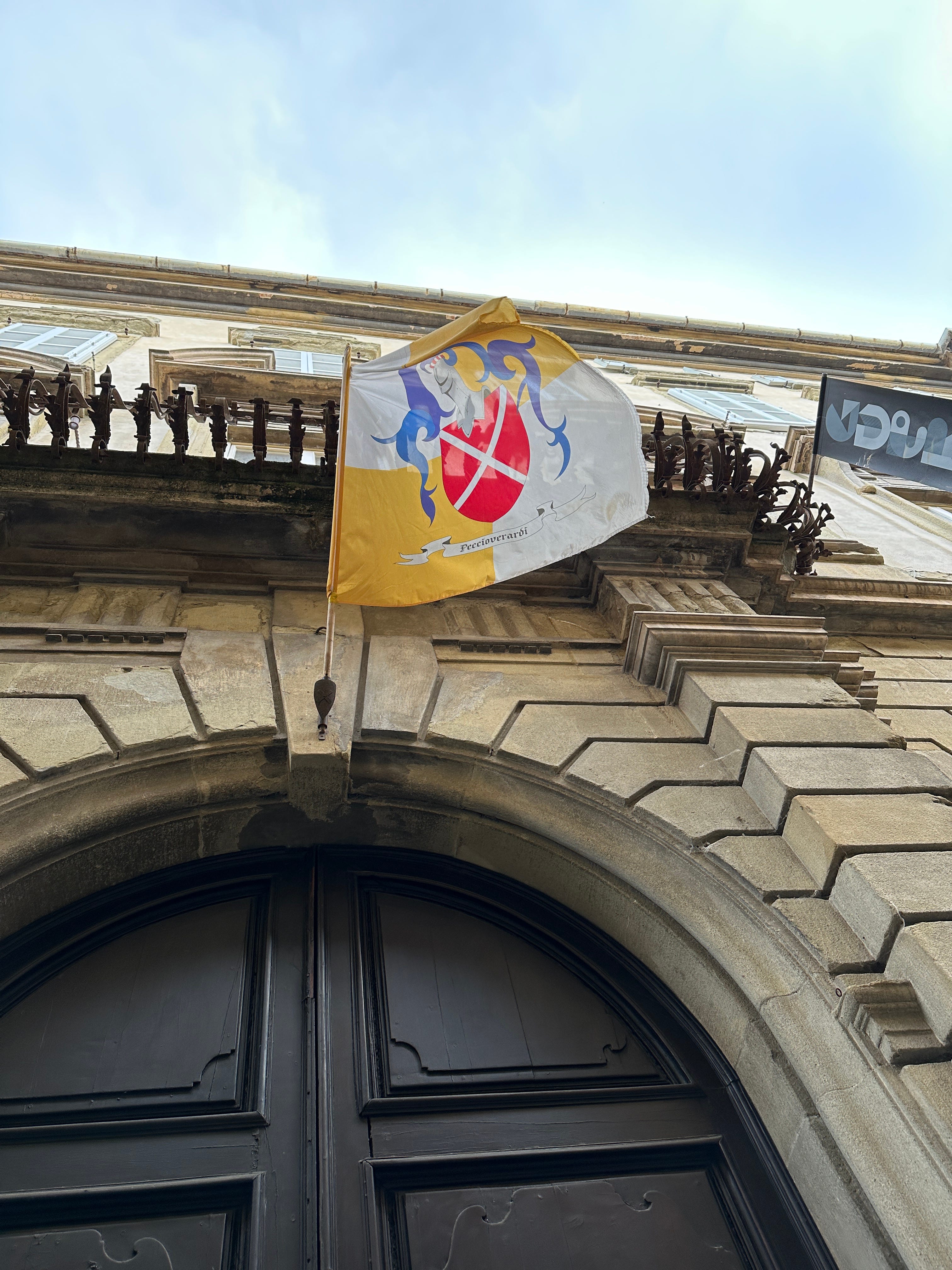
Greetings from sunny Cortona, where I'm happy to be performing at teaching at the Cortona Sessions for New Music. I'm more excited to be wandering amidst the fantastic city, an amalgam of Etruscan, Roman, Medieval, and Baroque architecture. Such. Great. FLAGS!
I'm writing because I'm starting a new weekly newsletter about practicing, called On Learning Percussion. I'm enclosing the first edition below. If you'd like thoughts and tips on practicing percussion, I'd love for you to check it out! Don’t worry, my missives on the world around us won’t stop!
Welcome to my weekly newsletter on practicing. While I anticipate speaking to a wide range of topics, I don’t anticipate future posts to be this long. I hope these prove useful, and that they might be saved for future reference.
Here are some thoughts on an under-served part of the practice session: warming up. I’m going to focus on the snare drum here, but hopefully some of the larger concepts apply to other instruments as well.
Boredom
In Atomic Habits, James Clear notes that “the greatest threat to success is not failure but boredom.” For musicians, “as as our habits become ordinary, we start derailing our progress to seek novelty,” which can hurt our long-term development. When we practice, we should incorporate routine to develop our technique. But, that routine should be constructed of creative play, which both keeps our minds engaged and develops the skills of musical expression.
Here are some thoughts on an under-served part of the practice session: warming up.
Warming up is not really warming up
While “warm up” time is a wonderful way to loosen our muscles before a practice session, I prefer to treat this time as a practice session unto itself. Before note learning, refinement, and incubation, I set aside time to develop my technique, refine and hone my sound (and my sensitivity to my sound), work on material closely related to my repertoire, and, most importantly, improve as a musician.
I’m going to keep calling this time “warm up” because I can’t think of a better name. “Pre-Practice” is taken, and “catch-all technical development” time doesn’t really roll off the tongue (pardon the pun)
Goals
When I warm up on any instrument, my goals are perhaps a bit broad:
Develop instrument-specific technique
I want to get good at the snare drum, so I’ll work on techniques that might get me there. I don’t want rudimental technique or orchestral technique. I want expressive technique that can be applied to solo music, chamber music, and, most importantly, any other instrument I can play.
Develop creativity
I want to be able to play with musical material, turn it around in my head. This play has the impact of increasing my capacity for critical thinking when looking at a new piece of music, and reducing performance anxiety. Plus, it makes practicing more fun. We rarely teach creativity on or through the snare drum, but we should!
Develop expressivity
My goal is not simply evenness, but a wide range of expressive ideas, inspired by the ear and executed by the hands with no hiccups.
Prioritize long-term results
I look for practices that will engender long-term results, not quick fixes. This often means privileging flexibility, ear training, repertoire knowledge and other compoundable skills rather than chasing near term “wins.”
Hone mental representation
Most importantly, I think about developing my mental representation for an instrument. A mental representation is a mental structure that corresponds to an object, idea, collection of information, or anything else, concrete or abstract, that the brain is thinking about. Basically, it’s a notion of what something is like when it’s “right,” incorporating information from all our senses. Mental representations help one diagnose mistakes and suggest changes, and are thus vital to our job as performers. They are honed through exposure and practice. So, when we warm up, our goal should be to develop our conception of what our instrument should sound like, feel like, look like, to connect our sound to our gestures. Warm up is a perfect time to develop these ideas—the musical material is typically not so challenging and thus there is more space to both widen our sound concepts while honing our sound preferences.
Themes
Some ideas to consider when warming up, or practicing anything:
Set timers
For each of my practice session, I set a timer. While it’s fun to hover over each technique, I want to make sure I cover each of them. If I have time, I’ll spend 30-50 minutes on this process total, with 5-15 minutes on each section, depending on what I determine I need the most. Since it’s a practice session for me, I don’t worry about it eating into other time in my day.
Constant Change
Tinkering with my physical movements—how I’m holding the stick, stroke, beating spot, muscle usage—and my musical ideas helps me determine which adjustments have which effect and help me play more expressively. It also significantly reduces the risk of repetitive stress injuries by keeping my motions linked to my conscious thought.
Have a notebook nearby
I like to keep track of my progress and make note of criticisms, ideas, and goals. I also seem to get my best non-musical ideas just as I begin to warm up, so keep that pen handy. You might need a 2nd snare drum just to hold the notepad.
Mirror
I use a mirror when I can, and typically sit or stand at an angle to it, so I can assess whether my weaker left hand is moving up and down without too much of a slice.
No practice pad, no mute, no snares no mercy!
How does this apply to other instruments? Always keep your ears on how you sound and how your motions contribute to or detract from that.
My Warm Up “Routine”
I warm up on the snare drum by playing around with 5 categories of music and technique:
Mind, Torso, Shoulder, Arm, Wrist, Finger, et. al. (10-15 minutes)
Grouping Notes: Rebounds, Forwards and Backwards (5-10 minutes)
Inverted Doubles (5-10 minutes)
Bounces (5-10 minutes)
ALMOST Repertoire (10-15 minutes)
Next time, I’ll dig into these zones more deeply. See you there!
Love all of this! I'm teaching a Theory/Aural Skills sequence this coming year and a big goal is to relate them as clearly as possible to the students' instrument(s) (i.e. not just singing). One of the ideas I had was assigning practice homework that could double as their warm up (3 types of exercises, 5 min each, 5 sessions/week), so this is affirming to see and really great food for thought in developing those assignments.
One thing I'm wrestling with here is how to create exercises that support, in contrast to your warmup, an instrument-general technique, that can be applicable across strings, winds, voice, and percussion. There's a lot of low-hanging fruit in the shared ground of scales, rhythms, etc., but I'm curious what aspects of technical thinking you've borrowed from other musicians that you'd be willing to share!